
Firms invest significant time developing producers, leaders and other high-performing employees who help drive enterprise value. These highly competitive, entrepreneurial individuals tend to seek ownership opportunities. The question is whether those creating that value also have a meaningful opportunity to participate in it.
Good intentions can become delayed action
Many firms recognize the value of expanding ownership and want their strongest producers and future leaders to have an opportunity to become owners. The challenge is turning intention into action. “Eventually” can easily become next year, the year after, or never.
Industry data illustrates the disconnect. Approximately 75% of respondents to MarshBerry’s 2026 Technology & Corporate Governance Report believe the next generation is capable of taking over their firm. Yet only about 20% said stock ownership is available to employees.
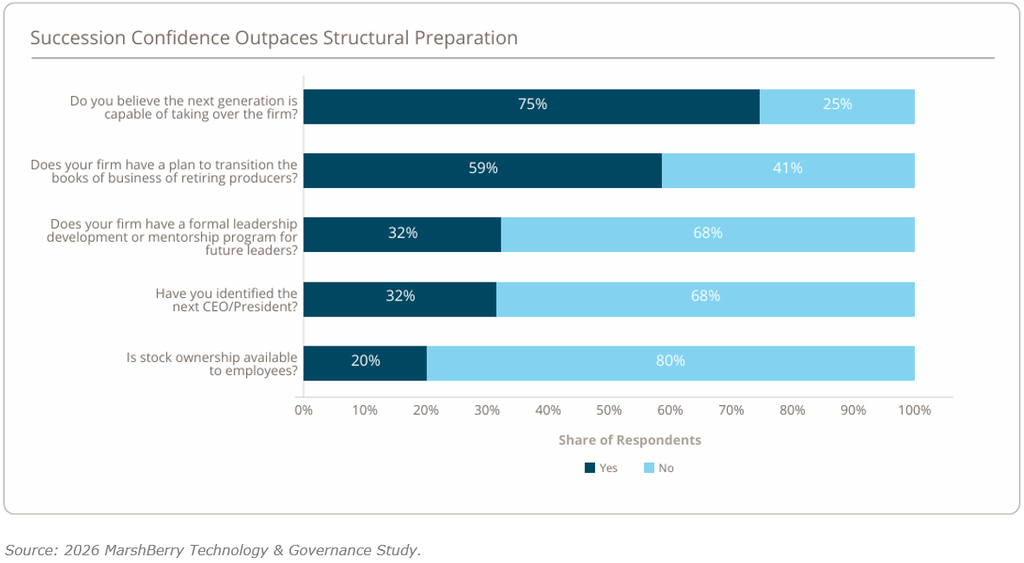
This matters because growth, valuation and succession all depend on people, and ownership structures influence behavior long before a transaction occurs. The obstacle is busyness and inertia. Start by identifying the firm’s goals, determine who may be ready for ownership (or could be coached toward it), evaluate the tools available – and begin.
Prepare for multiple scenarios
Owners may hesitate to establish an equity program because they do not know the firm’s ultimate path. Will the business remain independent and transition internally? Will it eventually pursue an external sale?
A well-designed program should work in either scenario. For firms that remain independent, equity can help develop the next generation of owners and support perpetuation. For firms that eventually sell, having a program established beforehand can strengthen retention, create cleaner deal mechanics and reduce the need for last-minute decisions about how key employees will participate in the value they helped create.
Waiting until a transaction is underway can produce a less optimal result. Last-minute wealth sharing tends to be reactive and rushed and may limit opportunities for thoughtful structuring and tax planning. Once a letter of intent is signed and the transaction clock is running, owners have fewer options and less time to make consequential decisions about rewarding key people.
Different goals call for different tools
Equity is not a single structure. Firms have several tools available, and each creates a different relationship between the participant and the business.
- True equity provides actual ownership. Participants purchase shares or LLC units and can share in sale proceeds, dividends or profit distributions. Depending on how the program is structured, ownership may also carry certain decision-making rights. Because participants put their own capital at risk, true equity can create meaningful “skin in the game.” MarshBerry generally views this as the preferred model when a firm’s circumstances allow it. But true equity also requires thoughtful planning. Owners need to determine valuation, purchase and sale mechanics, governance rights and what happens when a shareholder leaves. Structural considerations can matter as well. For example, a business owned through a bank or holding company may not be able to simply issue equity that directly tracks the growth and performance of the underlying insurance operation.
- Synthetic or phantom equity is not real equity but is an incentive program that aligns with the stock price. It generally ties a participant’s award to the value of the firm’s stock without transferring actual ownership. It can create an economic connection to enterprise value while avoiding shareholder rights, although payments are generally treated more like a cash bonus. These may not be tax-optimized and typically fall into the same category as deferred compensation.
- Growth or profit interests can reward participants for value created from a defined point forward rather than for value accumulated before they entered the program. This tool also does not give real ownership, but participation tends to be more tax-optimized and can set up future forms of equity participation. This can be useful when owners want key people to participate in future upside while preserving the economics associated with value already created. They are also complex and can be customized.
- Hybrid structures can combine elements of these approaches, giving firms additional flexibility to match different roles, objectives and circumstances.
The point is not to choose the most sophisticated structure. It is to first identify the goal and then select the tool that best supports it.
Equity can be an effective tool, but clarity on goals is key
The larger challenge around implementing effective equity programs is often psychological or fear of decision making. Owners may agree that aligning people through equity sounds attractive while still worrying about dilution, control or giving additional people a “seat at the table.”
Economic participation and governance should be designed separately. Thoughtful governance can define which decisions require shareholder involvement, which remain with senior leadership and what rights different classes or levels of ownership carry. Not every person who participates economically in the firm’s success needs an equal voice in every business decision.
This is why clarity about the objective matters. Is the firm trying to create the next generation of true owners? Reward people for future value creation? Strengthen long-term alignment without changing governance? Different answers may call for different tools and implementation.
Ownership can be particularly powerful because participants are not simply receiving another form of compensation. They are investing alongside existing owners and participating in both the opportunity and responsibility that comes with ownership.
That does not mean every high performer should immediately become a shareholder. Firms can start earlier and smaller, beginning with a select group of key people and building experience before expanding the program. Owners should ask: Who is ready? Who could become ready with coaching and development? And what form of participation is appropriate for each person?
Conclusion
Ultimately, designing an equity program is a strategic decision that impacts a firm’s growth, valuation, succession, and long-term independence. Owners can follow this process: identify the goals, identify the people, evaluate the tools and start now. The goal is not to predict whether a firm will perpetuate internally or ultimately sell. It is to establish an ownership strategy that can work in either scenario: rewarding the right people, reinforcing the right behaviors and preserving flexibility. The program should align key people who create value with the long-term value of the business and prepare the organization for whatever comes next.