
In this challenging recruiting environment, insurance agencies across the country are searching for their next generation of producers, owners, and executives. Yet many continue drawing future leaders from only a portion of their workforce. As succession challenges intensify and competition for talent grows, agencies may be overlooking one of the industry’s largest sources of leadership potential: women.
Creating stronger pathways for women to advance isn’t about meeting diversity goals. It’s about building a system that identifies, develops, and promotes the best leadership talent available. Agencies that do this well can strengthen succession plans, deepen their leadership bench, and position themselves for long-term growth.
Selecting future leaders
Building a stronger leadership pipeline starts long before promotion decisions are made. It begins with how agencies identify and recruit future leaders. Providing access to leadership roles should be less dependent on shared contacts, face time, or choosing someone already at the top. Insurance agencies often hire leaders based heavily on production history (i.e., top producers with large books of business), industry tenure, or an established network. That can unnecessarily narrow the candidate pool. Instead, agencies should consider leadership ability, relationship-building, operational expertise, and ability to develop others, alongside traditional production metrics.
It’s notable that women have not advanced much across the insurance industry. According to MarshBerry proprietary financial management system Perspectives for High Performance (PHP), women owners have increased less than 10% over the past five years.
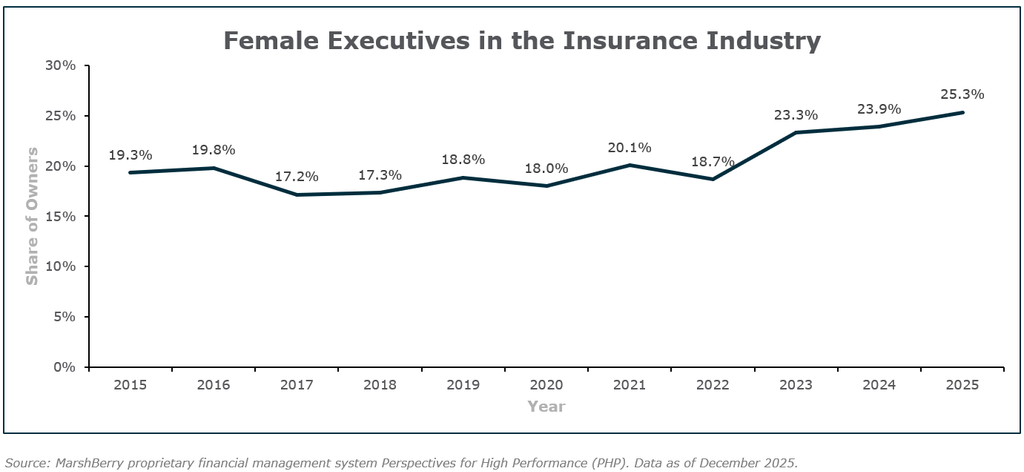
Considering that 66% of employees in insurance agencies and brokerages are women, they remain significantly underrepresented in leadership roles.1 If this trend persists, the insurance industry could lose significant current and future leadership talent.
Intentionally develop future women leaders
Insurance agencies that want more women in leadership should build a workplace where talented women can enter the leadership pipeline, see a credible path upward, and stay long enough to advance. Agencies need to make that path visible by clearly defining the qualifications and expectations required for advancement, including ownership opportunities such as partnership and equity.
In addition to defining advancement criteria, agencies can provide opportunities for employees to gain the experience needed to meet those criteria. By providing leadership responsibilities before a formal promotion, employees can build the skills and confidence required for advancement. Leadership responsibilities can include ownership of budgets, major client relationships, and strategic initiatives. Agencies can also support their development through mentorship and access to revenue-generating roles.
If the path to agency ownership or executive leadership runs through production, agencies should ensure everyone has meaningful opportunities to develop those capabilities. That includes becoming producers, building books of business, inheriting accounts, leading key client relationships, and participating in acquisitions rather than remaining confined to support functions.
Benefits of expanding leadership opportunities to women
Offering female employees more responsibility and senior roles isn’t just a nice gesture, it’s good for the business and the economy. For insurance agencies, the potential business outcomes include:
- A larger leadership talent pool: If women are underrepresented in senior roles, an agency may be overlooking capable leaders. Developing and promoting from a broader population increases competition for leadership positions and reduces dependence on a relatively narrow group of candidates. Visible female leadership can make an agency more attractive to candidates who evaluate employers based on advancement opportunities.
- Better retention of high-performing employees: Employees are more likely to envision a long-term career when they see people like themselves advancing into meaningful positions. A credible path to leadership can reduce the loss of experienced producers, account executives, and managers – and the substantial cost of replacing them.
- More perspectives in decision-making: Leadership teams composed of people with different professional and personal experiences can be less susceptible to groupthink and more likely to challenge assumptions. The benefit comes from diversity of perspective coupled with a culture in which leaders actually contribute those perspectives. Broader leadership teams can bring different networks, market insights, management approaches, and ideas about products and customer segments.
- Greater connection with clients and prospects: Insurance buyers themselves are increasingly diverse. Having a leadership and producer population that better reflects the marketplace can broaden professional networks, strengthen relationships with different decision-makers, and potentially create new business-development opportunities.
- A stronger succession pipeline: Many agencies face aging ownership and executive population. Developing more women for production, management, and ownership roles expands the number of credible successors rather than forcing an agency to choose from a small pool when senior leaders retire.
Overall, agencies that expand opportunities for leadership and ownership to women often develop a stronger employer reputation. Agencies that can point to women running functions, producing significant revenue, serving on executive teams, and owning equity have a more compelling story than firms that simply promote diversity initiatives.
A more diverse leadership pipeline offers significant opportunities, but ultimately, the results matter most. Tracking retention, promotions, producer productivity, succession coverage, recruiting success, client retention, and new-business growth can help agencies understand what’s working and where adjustments are needed. Ultimately, this isn’t just about representation of women in insurance. It’s about ensuring agencies develop leadership talent wherever it exists. Agencies that do so will be better positioned to recruit talent, retain top performers, strengthen succession plans, and sustain long-term growth.
Join us at In Motion
If you want to see an organization that supports women in leadership, learn how you can join us at the FirstChoice In Motion Independent Agent Member Conference. There are opportunities to network with like-minded professionals and hear from successful women on topics such as delegation, building resilience, and driving long-term success.